


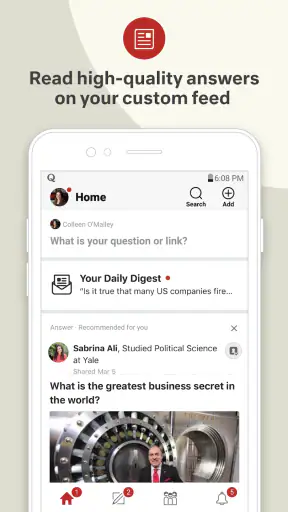
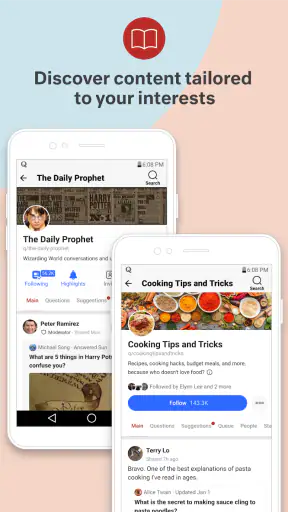
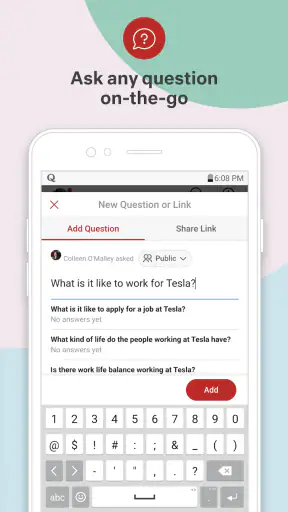
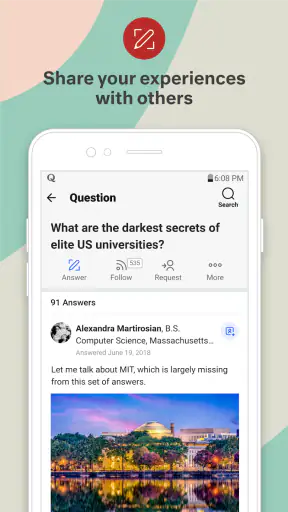
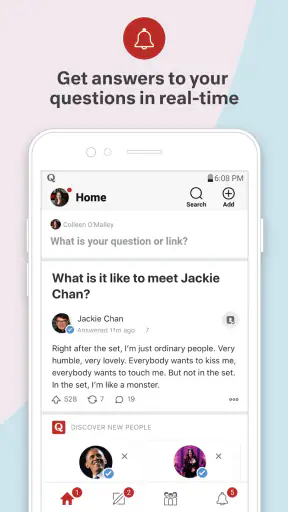
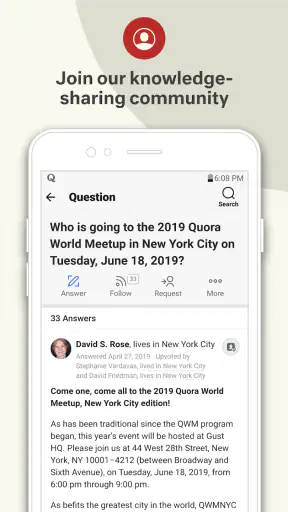
I use Quora when I want to see how different people explain the same subject, especially when a short search result is not enough. It is a question-and-answer app in the News & Magazines category, but that label only tells part of the story. In practice, it feels like a large public conversation organized around questions, personal experience, explanations, opinions, and follow-up discussion. The quality can be excellent, uneven, or somewhere in between, so the real decision is not simply whether to install it. It is whether you enjoy exploring several viewpoints and checking what you read.
Quora is best understood as a discovery tool rather than a final authority. I can use it to learn how people approach a career change, understand a technical phrase, compare everyday experiences, or find questions I did not think to ask. I would not use a popular answer by itself to make a medical, legal, financial, or safety-critical decision. That balance is central to the app: it can make unfamiliar subjects approachable, but it still requires judgment from the reader.
How I Decide Whether Quora Fits My Reading Habits
My first test is intent. If I want a stream of short headlines from established publications, a dedicated news reader is usually a better match. If I want a quick fact with a clear source, a search engine or reference site may be more efficient. Quora becomes more useful when I want context, lived experience, competing interpretations, or a question explained in ordinary language.
The second test is tolerance for open-ended browsing. A question can lead to several answers, then to related questions, then to a completely different topic. I find that helpful when I am researching broadly, but it can also turn a five-minute visit into a long scroll. The app rewards curiosity more than strict task completion.
I also pay attention to how much verification I am willing to do. Some answers are carefully reasoned and transparent about their limits. Others sound confident without offering enough support. The writing style, the author’s experience, the date of the answer, and agreement with reliable outside sources all matter. Quora gives me material to evaluate; it does not remove the need to evaluate it.
That makes the app a particularly good companion for early-stage research. For example, when I am considering a new software tool, I may first look for questions about common frustrations, learning curves, or practical workflows. Those answers can reveal concerns that a product page will not emphasize. I then verify important claims elsewhere before acting on them.
A realistic everyday session
Imagine that I am preparing for an interview in an unfamiliar industry. I can search for questions about what beginners misunderstand, what a typical workday feels like, and which skills people wish they had developed earlier. I might save a few useful explanations mentally or return to related discussions later. This gives me vocabulary and perspective before I read formal career guides.
The same workflow works for travel planning, hobbies, study topics, and household decisions. I can begin with a broad question, notice the distinctions people make, and use those distinctions to improve my next search. The important insight is that Quora often helps me formulate better questions. That is a different benefit from simply delivering a single answer.
What makes its question format valuable
Traditional news apps organize content by publication, topic, or chronology. Quora organizes much of the experience around what people want to understand. That structure is useful when my interest does not fit neatly into a headline. A question such as “What do beginners usually get wrong?” invites a different kind of response from “What happened today?”
I also appreciate the possibility of comparing explanations side by side. One person may focus on theory, another on personal experience, and another on practical steps. The disagreement is not automatically a flaw. Sometimes it shows that the subject depends on context. My job is to separate useful nuance from unsupported certainty.
For readers who dislike crowded social feeds, this format can still feel more purposeful than a general network because the subject begins with a question. However, it remains a social reading environment, so personalities, strong opinions, and repetitive arguments are part of the experience. People looking for a quiet, edited reference library may find that distracting.
Where the app wins against common alternatives
Compared with a conventional news app, Quora is stronger when I want explanations rather than updates. A news article can tell me what happened, while an answer may help me understand why people interpret the issue differently. That does not make one universally better; they serve different stages of learning.
Compared with a search engine, Quora can be more revealing when the question is subjective or experience-based. Search results often point me toward pages optimized for a broad audience. Quora may expose the practical details people include after trying something themselves. The trade-off is that the answer quality is less consistent, so I spend more time judging credibility.
Compared with a tightly edited encyclopedia, Quora is more conversational and personal. I may discover useful examples, mistakes, and edge cases that formal reference material leaves out. On the other hand, an encyclopedia is usually the better first stop for stable definitions and foundational facts. I see Quora as a layer of interpretation, not a replacement for carefully maintained reference work.
Compared with discussion forums built around one hobby or profession, Quora offers broader subject coverage. That breadth is convenient when my interests change frequently. A specialized community may still be better when I need deep technical troubleshooting, established terminology, or a group that shares a very specific context.
Useful habits that improve the experience
I get better results when I search with a narrow question instead of a single broad keyword. Adding the situation, skill level, or decision I am facing helps me find more relevant discussions. For instance, a question about learning a language while working full time is more useful to me than a vague search for language advice.
I also read beyond the first answer. The most visible response is not necessarily the most accurate or practical one. Looking at several answers helps me spot common ground, identify disagreement, and notice when a claim depends on a particular country, profession, age group, or personal history.
Another useful habit is separating experience from evidence. A person describing what worked for them can give me a valuable starting point, but their outcome may not generalize. I treat personal stories as clues about possibilities and constraints, then look for stronger sources when the decision matters.
When a topic is sensitive, I avoid treating popularity as proof. A persuasive explanation can still be incomplete. I look for specific reasoning, appropriate qualifications, and consistency with information from trusted professional or official sources. This is especially important for health, money, law, education requirements, and anything involving personal safety.
Where the experience becomes frustrating
The open nature of the platform creates unevenness. Some answers are thoughtful and carefully written, while others are repetitive, overly absolute, or driven more by personality than by evidence. I sometimes have to sift through several responses before finding one that addresses the actual question.
Long answers can also hide the most useful point. I prefer responses that define the situation, explain the reasoning, and acknowledge exceptions. When an answer spends too much time presenting one personal view as a universal rule, I move on. The app is most rewarding when I approach it as a reader who compares, not as someone waiting for a single definitive verdict.
There is also a difference between browsing for insight and searching for an immediate solution. If I need a precise instruction, an official manual, a support page, or a focused tutorial can save time. Quora may help me understand the problem, but it is not always the fastest place to complete a task.
Who should choose an alternative instead
I would steer a person toward a conventional news app if their main goal is following verified reporting in a predictable format. Quora is not my first choice for a morning briefing or a clean chronological overview of current events. Its strength is discussion and interpretation, not a uniform editorial package.
I would choose a reference source when I need a concise definition, a structured overview, or information that should be checked against a recognized authority. I would choose a specialized forum when I need detailed advice from a narrow community with shared tools and terminology. I would choose a search engine when I already know exactly what page or instruction I need.
Quora may also be a poor fit for readers who become frustrated by disagreement or who prefer every item to have the same editorial standard. The app asks for active reading. If I do not want to compare perspectives, inspect context, and occasionally verify claims, its breadth can feel like noise rather than value.
What switching to Quora really involves
The financial barrier is simple because the app is free. The bigger cost is attention. To use it well, I need to spend time refining searches, opening more than one answer, and deciding which ideas deserve further checking. That investment pays off when I am exploring a subject, but it is unnecessary for a straightforward fact.
There is also a habit change. A traditional news reader encourages me to scan a prepared selection. Quora encourages me to follow questions and let one topic lead to another. I enjoy that when I am in learning mode, but I set a purpose before opening it if I have limited time. Otherwise, the variety can make the session less focused.
People moving from a specialized forum may notice a loss of depth in exchange for wider coverage. People moving from a search engine may notice more personal context but less certainty. People moving from a reference app may appreciate the human explanations but miss a consistent structure. Knowing which trade-off matters most makes the choice easier.
Platform details and practical expectations
The app comes from Quora, Inc. and is available at no purchase price. It carries a Teen age classification, which is a useful reminder that the conversations may include mature themes, strong opinions, or subjects that require judgment. I would still guide younger readers toward appropriate topics rather than assuming every discussion is suitable.
Quora has been available since September 5, 2012, and its current version is 3.2.41. It supports devices running Android 7.0 or later. Those details matter if I am installing it on an older phone, although the more important practical question is whether my device and reading habits can handle a large, continuously changing knowledge community.
Its scale is reflected in more than 50 million installs, with an average rating of 4.1 from around one million ratings. Those figures suggest broad interest, but they do not guarantee that every topic will be equally useful. My own experience depends heavily on the questions I follow and how carefully I assess the answers.
My recommendation after using it
I recommend Quora to curious readers who enjoy learning through questions, comparing personal perspectives, and discovering angles they would not find in a standard headline feed. It is especially useful at the beginning of research, when I am trying to understand the vocabulary of a subject or identify the practical questions that deserve deeper investigation.
I do not recommend relying on it as the only source for important decisions. For those situations, I use it to gather perspectives and possible follow-up questions, then move to official, professional, or well-established reference sources. That workflow preserves the app’s main strength without confusing conversation with authority.
My final view is positive but deliberately measured: Quora is a strong curiosity engine, not an automatic truth machine. If you want a personalized stream of questions and explanations, it can become a useful daily learning tool. If you want tightly edited news, definitive reference material, or instant technical instructions, another category of app will probably serve you better. I would install it for exploration, keep my critical judgment switched on, and use its answers as a starting point for better questions.


